

The “conservative” Catholic position repeatedly protects the post-Conciliar settlement by separating admitted consequences from their governing causes. When the disorder becomes impossible to deny, the answer is: “That is not what Vatican II intended”; “that is not what Sacrosanctum Concilium (SC) mandated”; “that is not what the Pope meant”; “this resulted only from false interpretation, abuse, or defective implementation.” While the effects are admitted, the authoritative texts, principles, and decisions that gave them direction are protected from judgment.
The New Mass supplies the clearest test. Our thesis is that the reform’s governing direction was not invented later. At the level of principle and direction, what is now called devolution follows the expansionary logic SC made available and Paul VI publicly selected before the new rite took effect. While later practices sometimes passed beyond SC’s residual safeguards, the road was already open, and Paul VI had chosen its direction.
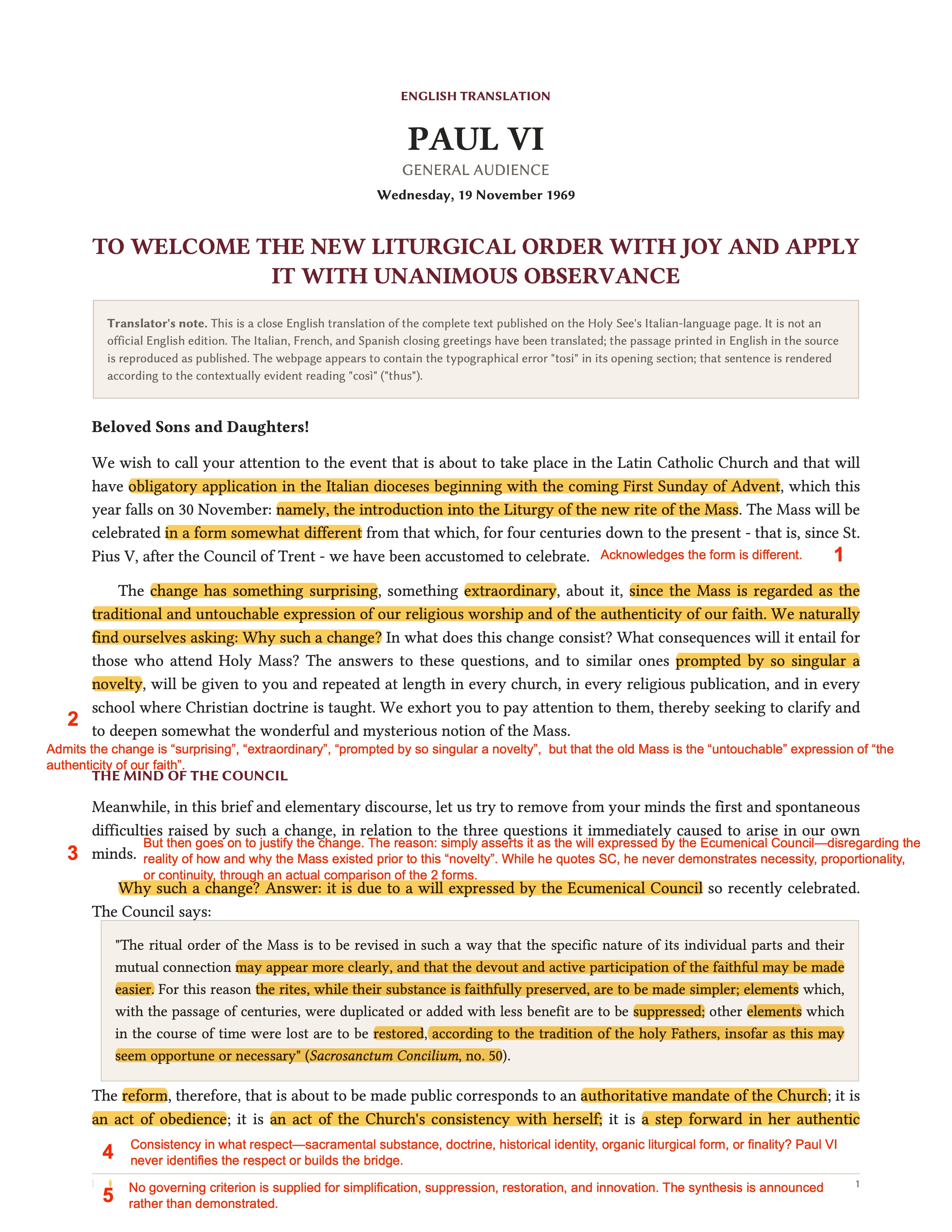
In the General Audience of November 19, 1969, Paul VI acknowledges a changed liturgical form, an “extraordinary” change, and a “singular novelty,” but never shows how the revised form remains organically continuous with the received Roman Mass. Instead, even as they present the reform as putting “an end to uncertainties, discussions, and arbitrary abuses” and restoring “uniformity,” Paul VI introduces tensions that the address never adjudicates, moving among authority, substance, interpretation, and desired effects before carrying them into a “new epoch.” The verdict is given before the case, but the case is never made.
A Note on Length and How to Read this Essay
Conciliar and post-Conciliar texts often compress doctrinal, liturgical, juridical, historical, pastoral, and psychological claims within the same passages, moving among these registers without demonstrating their relation. A responsible critique must separate and judge them; this is why the analysis is longer than the address itself.
Readers who want the complete textual demonstration may proceed in the usual way. Those who already accept the textual diagnosis may proceed directly to The Council’s Reforming Architecture: Sacrosanctum Concilium. Readers seeking only the final synthesis may proceed to Paul VI’s Announcement and the Philosophical Architecture of the Council and the Postscript.
The Missing Bridge
The address itself supplies the order in which it must be examined. Paul VI begins by acknowledging: 1) that the Mass will now be “celebrated in a form somewhat different” from that which Catholics had been accustomed to celebrate since St. Pius V; 2) that the change has “something surprising”and “extraordinary”; 3) that the Mass is regarded as “the traditional and untouchable expression” of Catholic worship and “of the authenticity of the Faith”; and 4) that the questions surrounding the reform are prompted by “so singular a novelty.” These are the conditions Paul VI places before the reader (see comments 1 and 2).
References to numbered comments throughout are to the annotations in the accompanying English translation of Paul VI’s General Audience of November 19, 1969. Because we have already distinguished continuity of authority, sacramental substance, and liturgical form in What Paul VI Unleashed, we will not repeat that complete metaphysical demonstration here. The narrower question is whether this address supplies the organic relation it declares.
Authority in Place of Formal Judgment
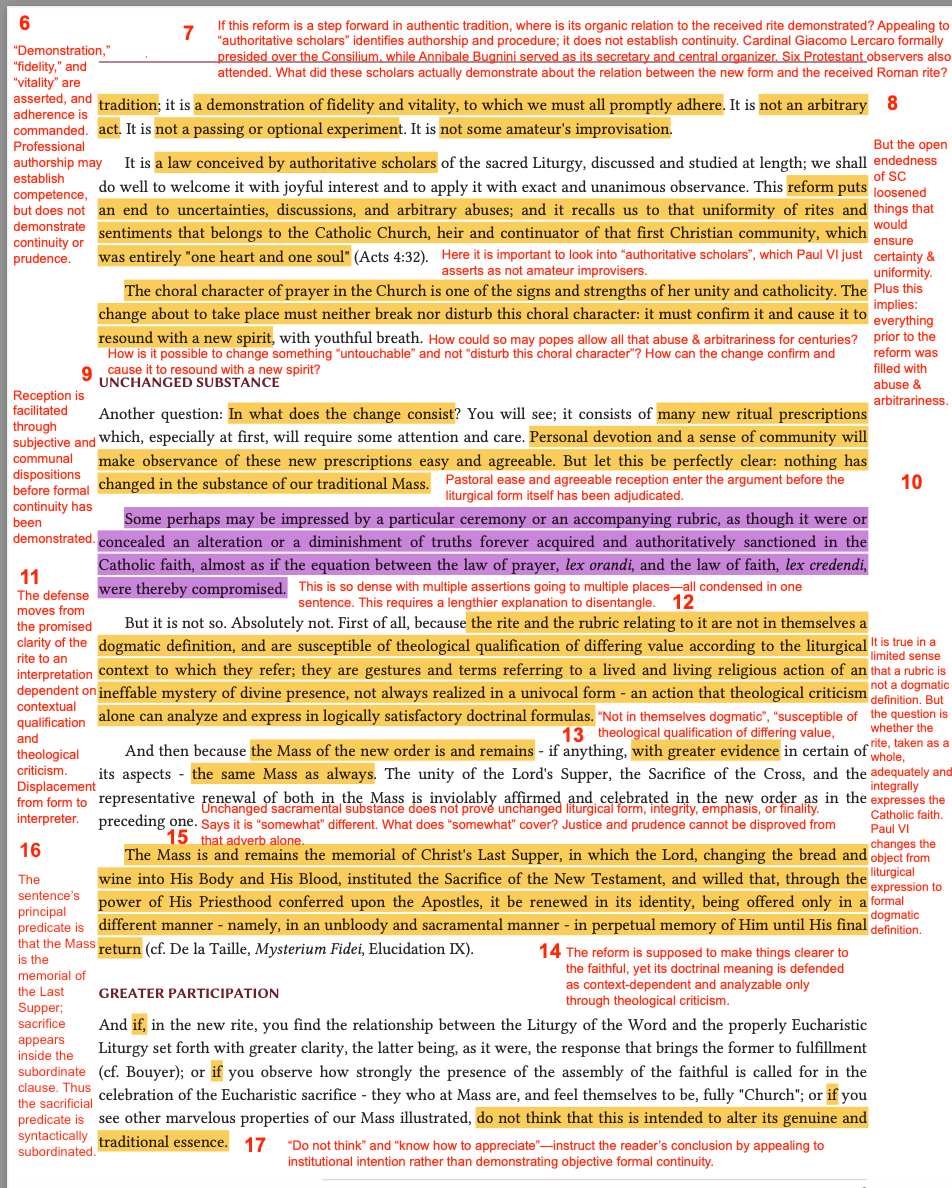
They then formulate three questions: “Why such a change? In what does the change consist? What consequences will it produce?” Although these are the correct questions, the problem is that they are answered on different planes, without the relation between those planes ever being demonstrated. Question 1: “why such a change?” is answered by appealing to “a will expressed by the Ecumenical Council” (see comment 3). Paul VI then identifies the reform as “an authoritative mandate”, “an act of obedience”, “an act of the Church’s consistency with herself”, “a step forward in her authentic tradition”, and “a demonstration of fidelity and vitality” (see comments 4 and 5). It is “a law conceived by authoritative scholars”, “discussed and studied at length”, and must therefore be applied “with exact and unanimous observance”. Hence, the faithful must promptly adhere to it.
These claims establish the reform’s source, authorship, authority, and obligatory character. But they do not show why the received form required this change or how the revised form grows organically from it. As we demonstrated in The Exchange that Reveals the Crisis since Vatican II, juridical authority may bind, but it cannot answer the prior question of form. Expertise may identify the reform’s composers; it does not establish its continuity or prudence (see comments 6 and 7).
Unchanged Substance Does Not Establish Formal Continutiy
The second question—“In what does the change consist?”—appears to return the address to the object. Paul VI acknowledges “many new ritual prescriptions” but immediately assures the reader that “nothing has changed in the substance of our traditional Mass.” Yet “substance” remains undefined. If it means the sacramental essentials required for validity, their preservation does not establish continuity of liturgical form. If it means the traditional Mass’s broader doctrinal, ritual, and historical identity, that identity is precisely what must be demonstrated (see comment 15).
Here, “liturgical form” means the received Roman rite’s objective configuration—its ordering, signification, emphases, and finality—not merely the sacramental form required for validity.
From Liturgical Form to Contextual Interpretation
The address then changes planes again. Faced with the possibility that altered ceremonies and rubrics might affect the relation between lex orandi and lex credendi, Paul VI answers that rites and rubrics are not themselves dogmatic definitions and may receive different theological qualifications according to their liturgical context. This densely compressed answer moves from the objective rite, to dogmatic definition, to contextual interpretation and theological criticism (see comment 12). While the statement that a rite is not itself a dogmatic definition is true in a limited sense, it does not answer the objection (see comment 13). The question is whether the revised ritual form continues to embody and express, clearly and integrally, the Catholic doctrine already carried by the received form (see comments 11 and 14).
Doctrine Stated vs. Doctrine Embodied
Paul VI thereafter gives an explicitly Catholic account of the Mass, affirming the Last Supper, the Sacrifice of the Cross, and its unbloody and sacramental renewal. Later, they also expressly call the sacrifice propitiatory.
Nevertheless, rhetorical order matters. By identifying the Mass principally as “the memorial of Christ’s Last Supper” while placing the institution and renewal of the Sacrifice in subordinate clauses, the sentence foregrounds a term capable of reductive interpretation precisely when Paul VI is answering concern over the Mass’s sacrificial and propitiatory character (see comment 16). While this does not by itself establish theological diminishment, and the sentence remains doctrinally Catholic—from the Holy Father, in this context, its ordering is high-risk.
More fundamentally, doctrine stated about a rite does not establish that the reconstructed rite embodies that doctrine with the integrity of the received form.
Desired Effects in Place of Formal Judgment
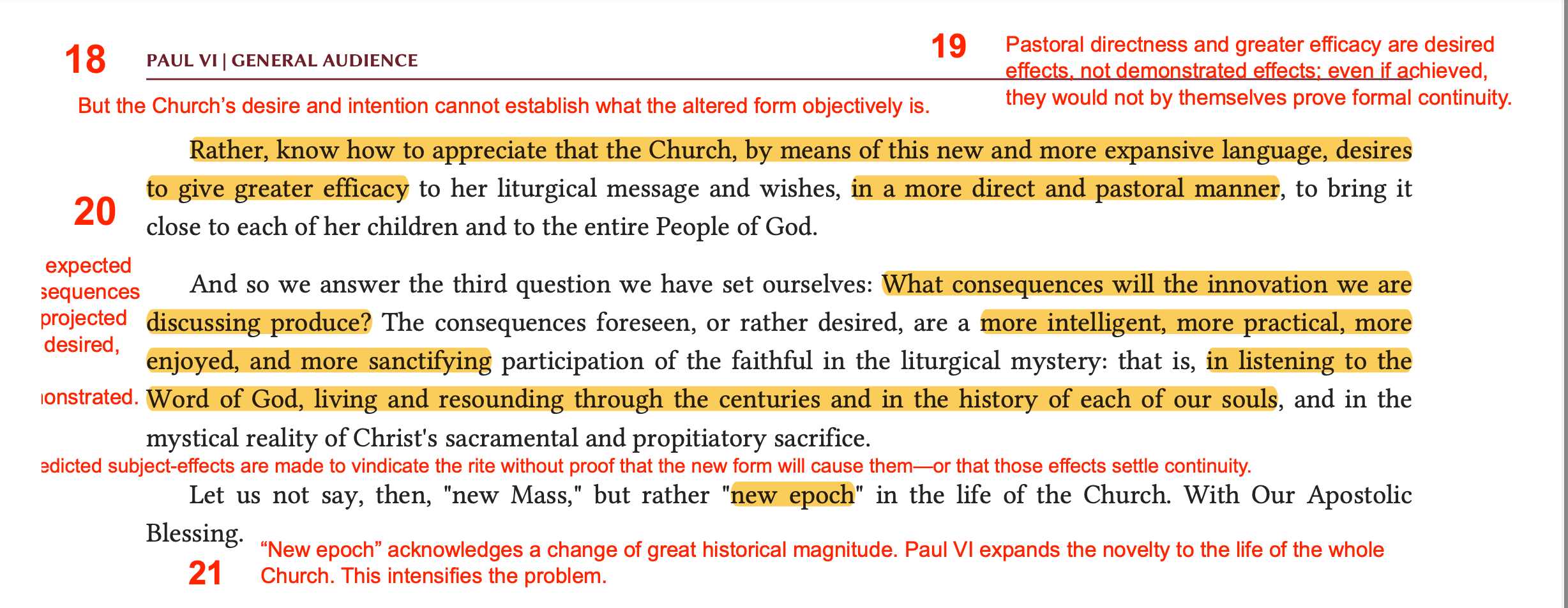
Before returning to the third question, Paul VI has already moved from the objective form toward its anticipated reception. “Personal devotion and a sense of community” will make the new prescriptions “easy and agreeable” (see comments 9–10). The faithful are then instructed not to think that the reform alters the Mass’s traditional essence, but to “know how to appreciate” what the Church intends through it (see comment 17). The Church “desires” to give its liturgical message “greater efficacy” and to bring it to the faithful in a “more direct and pastoral manner” (see comments 18–19). These may be desired goods, but none establishes what the altered form objectively is or demonstrates its organic continuity with the received form. Institutional intention and anticipated reception have entered precisely where formal comparison remains absent.
Paul VI next returns to the third question: “What consequences will the innovation produce?” They initially call the consequences “foreseen,” but immediately correct this to “or rather desired”: more intelligent, practical, enjoyed, and sanctifying participation. The correction changes the kind of claim. A prediction may be falsified by contrary effects; a stated intention cannot. Judgment is thereby moved from what the form objectively produces to what authority intends it to produce—the wider displacement from object to intention examined in The Conciliar Legacy: The Displacement of Judgment from Truth to the Primacy of Intention. Whatever Paul VI’s conscious purpose, this is how the formulation functions (see comment 20).
The order is therefore reversed: instead of the liturgical form governing interpretation and reception, the reception desired from it is made to vindicate the altered form.
The Culmination of Novelty: From a Changed Form to a “New Epoch”
This language warrants calling the reform “revolutionary” at the level of form— because it authoritatively reconstitutes the received liturgical form without demonstrating the organic relation between them. Rather than returning to that relation, Paul VI assigns the reform a historical meaning: it is “a step forward,” invested with “a new spirit” and “youthful breath,” and presented as inaugurating a “new epoch.” What begins as the announcement of a changed liturgical form therefore ends as the announcement of a new ecclesial epoch (see comments 1–2 and 21).
Because the speaker is the Holy Father, the burden is higher, not lower. We have already established why office and end require this standard in The Cost of Ignoring Normative and Metaphysical Judgment.
The Council’s Reforming Architecture: Sacrosanctum Concilium
Paul VI’s Udienza Generale of November 19, 1969 does not invent a rationale foreign to SC’s constitution. Rather, it operationalizes SC’s reforming architecture. The structural correspondence is unmistakable, and it begins even before SC23 establishes the norms supposedly governing the “reform.”
But before those norms can govern the “reform,” a logically prior question needs adjudication: why did the received Roman rite require a general “restoration” in the first place? SC declares: 1) there are “particularly cogent reasons” for undertaking liturgical reform (1); 2) makes full and active participation the aim “to be considered before all else” (14); 3) announces the Church’s desire for a “general restoration” and states that mutable elements may—and under certain conditions “ought”—to be changed (21); and finally 4) commands that the rite of Mass be revised (50). These provisions supply asserted motives and desired ends, but they do not demonstrate through an objective comparison of the received rite with its nature and finality why a general revision was necessary, which defects required correction, or why the mandated scale of alteration was proportionate.
The designation “reform” therefore contains the verdict it should first have to prove. To reform is to correct something toward its proper form. The word consequently presupposes that the received arrangement was defective in the relevant respects and that the projected changes would restore or improve it. But SC does not demonstrate either proposition. Before the norms governing the “reform” are even applied, the reader has already been enclosed within the prior judgment that reform is necessary and that its movement constitutes legitimate progress. The question has been narrowed from whether the received form requires reform to how the reform already authorized will be carried forward.
SC23 embodies the argumentative structure later found in the Udienza Generale. It begins by declaring the compatibility of “sound tradition” and “legitimate progress” but does not identify the formal criterion by which progress will be distinguished from rupture. It locates the adjudication of that relation within theological, historical, and pastoral investigation. The problem is these are made to occupy the place of the missing bridge. And so the received form no longer governs as the prior and objective measure, and whether tradition has been retained becomes the conclusion of an interpretive process.
And let’s zoom into this interpretive process. Historical investigation, for instance, can establish that a practice existed at a particular period; it cannot by itself establish that the practice ought to be restored or should govern the received rite as a whole. But selecting among historical periods and precedents already requires judgment. Pastoral investigation adds another contingent register: usefulness, intelligibility, participation, and reception. Although SC also requires study of “the general laws governing the structure and meaning of the liturgy,” it does not make those laws concretely dispositive over the historical and pastoral considerations placed beside them; their application is instead joined to recent liturgical reforms and juridical indults. The process can be very messy.
Even SC’s strictest safeguards remain interpretively elastic. Innovations must be “genuinely and certainly” required, but no determinate measure of that necessity is supplied; and new forms need only “in some way” grow organically from existing forms. “Genuinely and certainly” supplies emphatic restraint without an objective test, while “in some way” loosens the organic relation it appears to protect. The restrictions therefore remain dependent upon the judgment of those applying them—another layer of messy.
While the method may suppress unauthorized arbitrariness, it can also expand authorized discretion. We have already traced how SC’s permission structure opened the interpretive field later defended as merely an “implementation problem” in Taylor Marshall and the Conciliar Displacement of Judgment. Here the crucial point is: the safeguards remain dependent upon the judgment of those applying them rather than supplying an objective measure by which their application may be judged.
Read together with SC 22, 25, and 44, these norms belong to an institutional process in which ecclesiastical authorities commission and approve the reform while appointed experts investigate and compose it. The same reforming apparatus is therefore empowered to produce and authorize the “reform,” interpret “sound tradition,” “legitimate progress,” genuine and certain necessity, and organic growth “in some way,” and then certify that its own work has fulfilled them. While the traditional form is not expressly rejected, it is enclosed within a process whose authors are also authorized to judge whether they have preserved it. Not only is this potentially messy, it is extremely centralized, managerial, and anthropocentric—and does not at all resemble anything organic.
We can say, Paul VI’s address operationalizes this sequence: the Council’s will stands in for necessity; authority, law, and obedience for legitimacy; expert authorship for prudence; unchanged substance for continuity; and desired effects for justification. But they never demonstrate that the innovations were genuinely and certainly required or that the revised form grew organically from the received Roman rite.
Paul VI’s Announcement and the Philosophical Architecture of the Council
Read together, SC and Paul VI’s address disclose a compressed philosophical architecture. We have developed these analogies more fully in Form Before Obedience and The Encyclical of Perpetual Arrival. Here they are applied specifically to this address.
Used analogically—without alleging conscious dependence upon Descartes, Kant, or Hegel, or the successful execution of a formal Hegelian dialectic—three classifications name its observable structure: Cartesian in its enclosure, Kantian in its lenses, and Hegelian in its movement.
Cartesian. The difficulties raised by the changed rite are placed inside a juridical-pastoral plane whose governing conclusion is already fixed: the Council willed the reform, authority promulgated it, and adherence is required. The object that should be judged—the relation between the received and revised forms—therefore recedes behind institutional declaration, intention, and reception. The question is admitted only after the answer has become law.
Kantian. The reform is apprehended through subject-facing criteria—clarity, ease, participation, communal feeling, pastoral proximity, and enjoyment—which are made to vindicate it before its objective continuity of form and finality has been demonstrated. The rite is judged by how it lands before it is judged by what it is.
Hegelian. The central juridical passage first assigns its predicates by anaphoric accumulation—a method we have examined more fully in Taylor Marshall & the Pseudo-Argument of the ‘Pseudo-Mandate’.
The Hegelian analogy appears first within the syntax itself. “A step forward in authentic tradition” grammatically fuses forward movement with preservation; the change must confirm the Church’s choral unity while making it resound with “a new spirit” and “youthful breath”; the new order “is and remains” the “same Mass as always”; and “not a new Mass” but a “new epoch” negates the narrower designation of novelty only to preserve and enlarge that novelty on a higher historical plane. In each case, tension-laden terms are joined before their relation is demonstrated. The syntax performs an asserted dialectical closure, not a genuine mediation.
The same compression governs the movement of the address as a whole. Its tensions—changed form and unchanged substance; novelty and restoration; untouchable tradition and progress; uniformity and broader language; received inheritance and youthful breath; continuity and a new epoch—are neither formally adjudicated nor carried forward neutrally. But the processual terms—“a step forward,” “a new spirit,” “youthful breath,” and finally a “new epoch”—consistently select the more adventurous rather than the more traditional pole. While continuity supplies the reform’s authorization and legitimating name, novelty determines its direction and result. Innovation is thereby presented as the historical fulfillment of tradition without demonstrating the mediation by which the novel form grows organically from the received form.
But this assigned synthesis is neither simply accomplished nor merely awaiting completion. Juridically, it is already settled: the reform is law and authentic tradition, the substance of the Mass is declared unchanged, and adherence is required. Formally, however, the relation remains unadjudicated and is deferred to interpretation, reception, desired effects, and historical unfolding. While the verdict has arrived, its demonstration is perpetually arriving. The missing mediation therefore cannot be excused on the ground that the process remains unfinished. Process has been installed in its place.
Conclusion
The address encloses judgment within a juridical-pastoral system in which the reform is already law, filters its reception through subject-facing categories, and presents novelty as tradition’s historical fulfillment. But the organic relation between the received and revised forms remains unproved. Paul VI’s verdict is final, but the case required to sustain it remains in perpetual arrival.
Postscript
As we neared the end of our article, we discovered another Udienza Generale on the New Mass delivered on November 26, 1969. This second address is not merely more of the same, as it makes explicit which side of SC’s reforming architecture would govern its implementation—and by which side we mean the more adventurous vs. the more traditional side.
Paul VI begins by acknowledging the magnitude of the change—it touches a venerable, centuries-old tradition and the Church’s inherited religious patrimony, which had placed upon her lips the prayers of her ancestors and saints and made her spiritual past present for transmission to future generations. They then acknowledge that, under the new rite, things at the altar will no longer proceed with the same identity of words and gestures and that pious persons will be the most disturbed. This is an important admission: the disruption of inherited liturgical continuity is not an unforeseen consequence that emerged years later or resulted only from subsequent implementation. Before the new rite takes effect, Paul VI already knows that major elements of the received liturgical inheritance are being surrendered. This is not hindsight. Paul VI announces the loss before the first obligatory Sunday.
More disturbing, however, is the inversion by which the address treats those who suffer the loss. Paul VI acknowledges them as “pious” and their manner of hearing Mass as “respectable,” but never permits the objective goods to which their piety is attached to place the reform itself under judgment. Instead, their personal devotions become something from which they are to be drawn away, their customary thoughts something they are “obliged” to exchange for others, and the resulting suffering a “disturbance” accompanying novelty. The faithful are instructed not to be surprised by the appearance and inconvenience of its “external forms.” And so the reform is not judged by the piety it disrupts, but the pious are judged by their difficulty in accommodating the reform. Piety is praised—and then treated as the adjustment problem.
But to begin with, the address does not demonstrate why this surrender is necessary or how it constitutes organic development. As in the November 19 address, Paul VI changes planes—obedience to the Council becomes obedience to the bishops who interpret and carry out its prescriptions; Paul VI then declares that it is the will of Christ and the breath of the Holy Spirit that calls the Church to this change and instructs the faithful to recognize in it a prophetic moment in the Church. But these claims of divine authorization heighten rather than remove the need for demonstration. Authoritative imposition is thereby made to function as the practical substitute for the missing judgment of the reform itself.
The treatment of Latin supplies the clearest example. SC36 declares that “the use of the Latin language is to be preserved,” but immediately authorizes the extension of the vernacular and entrusts its extent to competent ecclesiastical authority. SC54 allows an even “more extended use” through the process established in SC40, while retaining a residual provision that the faithful should be able to say or sing their parts of the Ordinary in Latin. SC114 likewise commands that the treasury of sacred music be “preserved and fostered with great care,” while SC116 gives Gregorian chant pride of place, but only “other things being equal.” SC’s text therefore joins preservation language to an institutional mechanism of expansion without establishing a determinate minimum of Latin actually to be used in liturgical celebrations or a maximum for the vernacular. And on November 26, Paul VI selects the expansionary pole: “Latin will no longer be the principal language of the Mass.” They judge that “intelligibility” and “participation” are worth more, expressly evaluating the inheritance through the communicative expectations of modern people. But the address does not demonstrate that replacing Latin with the vernacular will actually secure either greater intelligibility or greater participation.
Latin is then said not to have disappeared, but only after its function has been relocated. Paul VI assures the faithful it will not disappear as it will remain in official acts, ecclesiastical studies, cultural patrimony, and certain parts of the Ordinary. But preserving the existence of Latin is not the same as preserving its received liturgical position. Latin is removed as the principal language of the Mass and then presented as remaining because it survives elsewhere and in a residual liturgical capacity. Its principal liturgical position is surrendered while the Council’s word preservation remains—Hegelian sublation.
This defeats the familiar “conservative” account according to which SC mandated a modest reform retaining Latin, only for later reformers to exceed it. While preservation clauses remain, November 26 reveals their operative status as residual qualifications within an authorized expansion. Later practice sometimes exceeded those safeguards, but it did not invent the direction Paul VI had already publicly and authoritatively chosen.
Paul VI then asserts that the “fundamental design of the Mass remains traditional,” but again supplies no formal comparison by which this is demonstrated. Instead, they point to anticipated goods—simplicity, scriptural abundance, participation, communal charity, and spiritual enrichment—and make the rite’s greater richness conditional upon its proper execution.
The address then admits that no complete missal is yet available and that “many uncertainties” surround the rite’s application. Only one week earlier, Paul VI had declared that the reform would end “uncertainties, discussions, and arbitrary abuses” and restore “uniformity of rites and sentiments,” while SC itself required greater clarity and prohibited unauthorized innovation. Continuity is therefore asserted and the rite made obligatory before the complete missal is available and while its application remains uncertain.
The admitted “sacrifice of inestimable price” raises that burden still further: Paul VI must demonstrate, before making the rite obligatory, that the reconstructed form grows organically from what was received.
The “conservative” position then keeps the missing demonstration in perpetual arrival by attributing the consequences to misinterpretation, abuse, or defective implementation—admitting effects while protecting their governing causes. Paul VI made the more revolutionary pole operative, by defending that settlement as continuous with Tradition; “conservative” Catholicism preserves the direction it claims merely to contain. The continuity actually secured is not with the received liturgical form, but with the reform’s chosen course. And so “conservative” Catholicism is not the brake on the revolution. It is the ratchet—allowing movement farther along that course while preventing return to the received form. It appears to restrain the revolution while actually preventing its reversal.
For that, no misinterpretation is required.
Fr Z did a very entertaining series treating of this address of Pope Paul VI. Links in the body of the blog post: (https://wdtprs.com/2019/11/50th-anniversary-of-imposition-of-the-novus-ordo-podcazts-revisited/) Listening to this was actually one of my first steps toward tradition.
Fantastic! I can't wait to read this. Thank you Katharia!!
I just finished going through it. As usual, very well done with much clarity and the facts to back it up! 👍