
Form Before Obedience
An Appeal to Cardinal Sarah for the Good of the Church

Note: The article is not a criticism of Cardinal Robert Sarah as a person, nor a judgment of his intentions, in appealing to the SSPX not to proceed with the consecrations. It is a structural examination of the order of judgment presupposed in his recent appeal—an order that has characterized many arguments since the Council—and of the metaphysical questions upon which the good of the Church, in crisis, depends.
In our article, entitled, Four Levels of Explanation and Why Debates Never Resolve: The Case of Vatican II & the Crisis in the Church, we identified the reason why debates pertaining to the crisis in the Church have stalled because they proceed at the wrong level of reasoning. In the same article, we created an infographic to identify the structural pattern that runs through our corpus on the subject— Can the Novus Ordo Be Reformed, What Paul VI Unleashed, The Cost of Ignoring Normative and Metaphysical Judgment, Form Before Permission, The Exchange that Reveals the Crisis since Vatican II, Vatican II & the Success of Formlessness, and On Bishop Eleganti, the SSPX Consecrations, and the Order of Judgment--all of which lay out the ratio (discursive logic) that the metaphysical order (the highest level of judgment) requires.
Here we will focus on Cardinal Sarah’s recent appeal to the SSPX response to Cardinal Tucho Fernandez regarding the consecrations on July 1, 2026 in Econe, Switzerland. We first created an infographic, based on St. Thomas Aquinas’ hierarchy of the order of judgment while also invoking metaphors, which we believe helpful and perhaps even necessary at this point in time because: 1) we have already confronted the metaphysical and laid out the ratio—hence the proper premise from which these metaphors hence proceed; and 2) the crisis in the Church is 60 years old, and hence, would benefit from more rhetorical and polemical expression in order to sound the alarm on the cost of ignoring normative and metaphysical arguments now six decades old.
Our essential and fundamental premise/ argument is this—addressing issues without adjudicating form and telos (hence, ignoring the metaphysical order of judgment)—places one on a Cartesian plane, where you are likely to have Kantian lenses, and yield a Hegelian chain—hence noise and an entropic time loop.
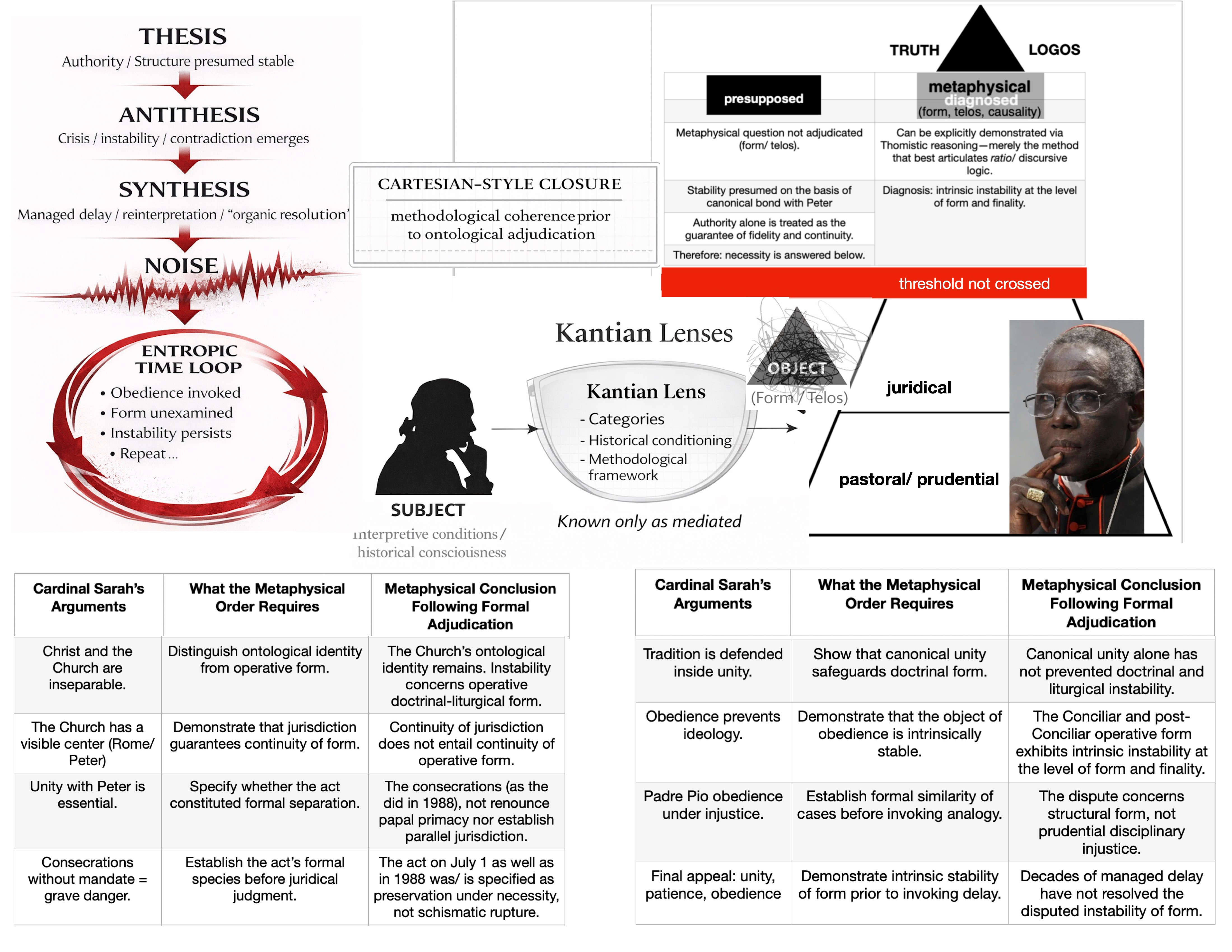
We begin by zooming into the upper right quadrant of the infographic, which we built from our first model here, to illustrate the metaphysical disconnect with the Conciliar argument/ position implicit in an exchange between Archbishop Lefebvre and Paul VI—which we in turn took from St. Thomas’ hierarchy in the order of judgment. We situate Cardinal Sarah’s recent appeal in the two lower levels, where the metaphysical (the threshold not crossed) is not engaged—further showing the contrast between what his arguments pre-suppose vs. what the metaphysical path can and has diagnosed. We will also note that any pastoral/ prudential and juridical resolve needs to first be premised on/ proceed from the level above (metaphysical).
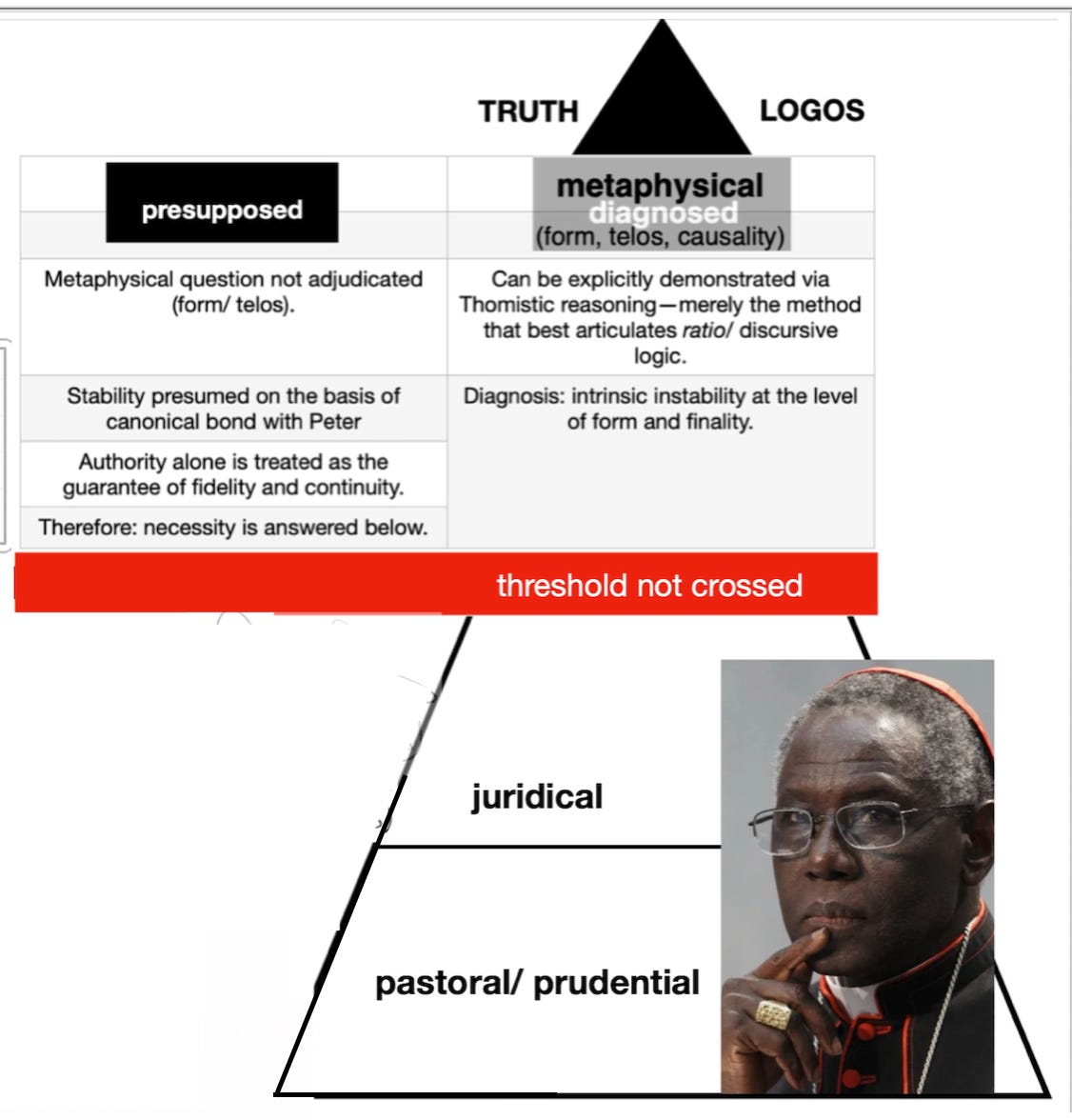
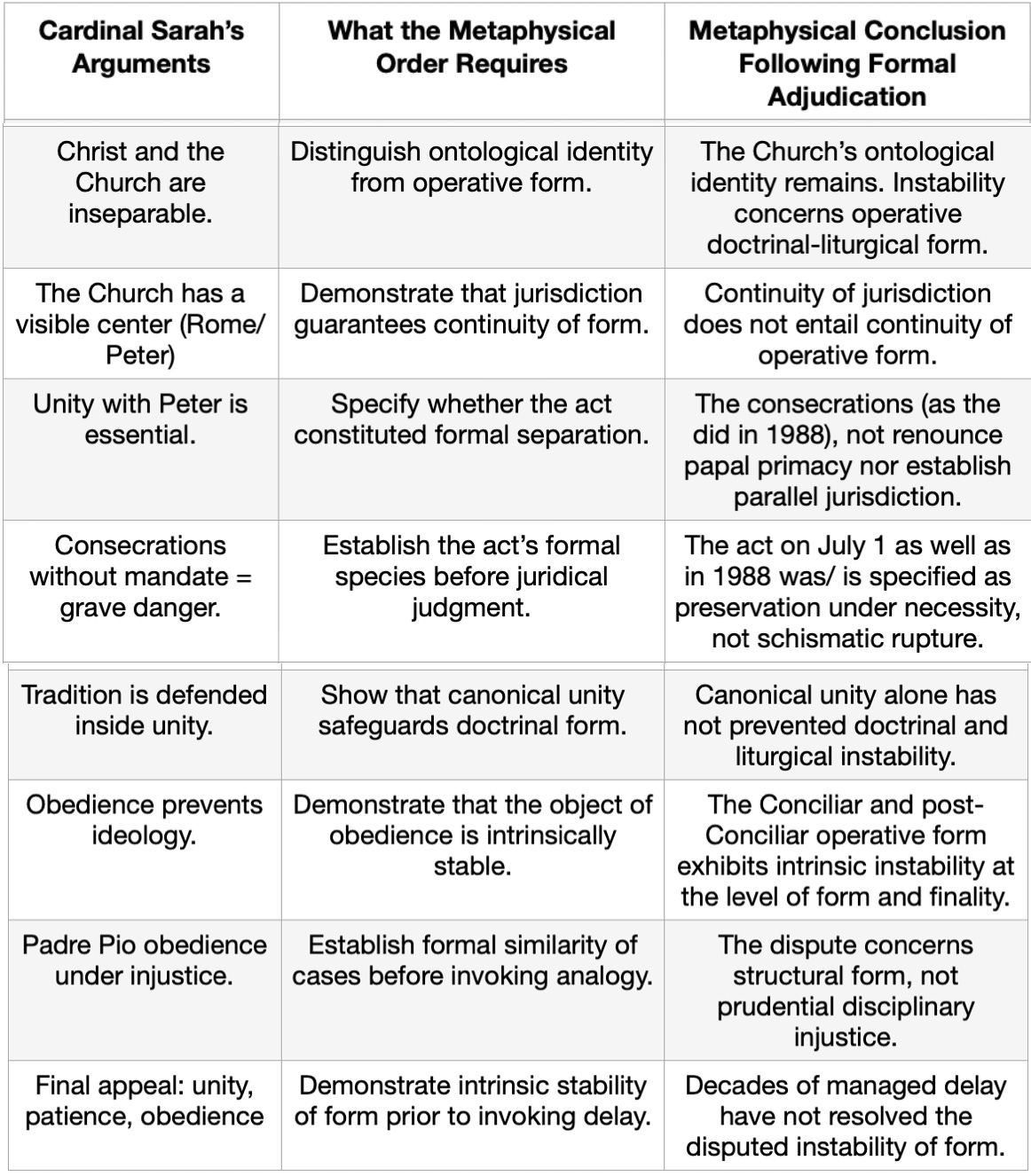
Next, we zoom into two tables that identify the Cardinal’s main arguments and subject them to metaphysical rigor by pinpointing what the metaphysical order requires for the argument to be coherent within the larger context of the order of judgment. In addition, we reveal the metaphysical conclusion for each argument, following formal adjudication—the ratio (discursive logic), culled from our corpus, enumerated at the beginning of this article.
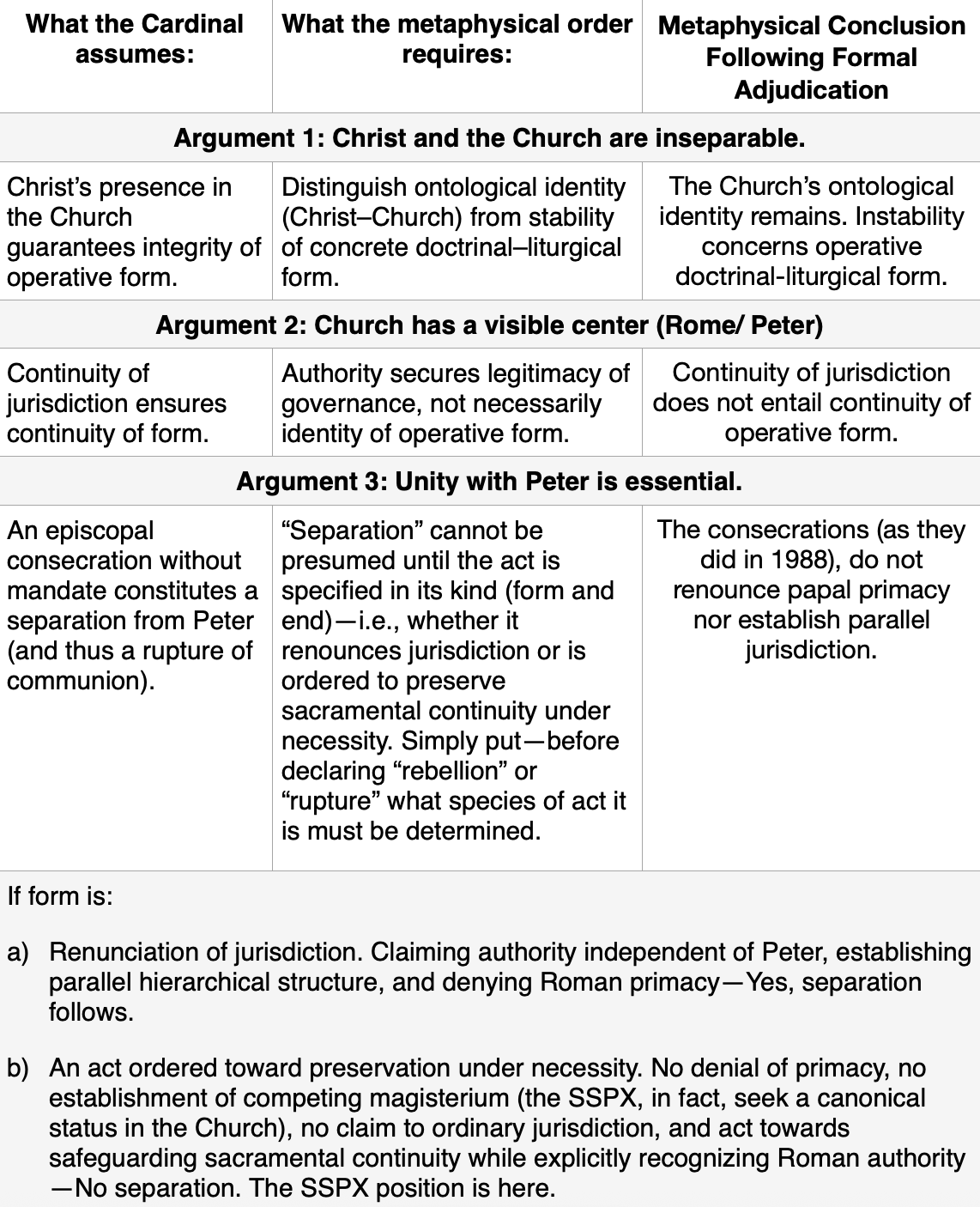
We provide further missing steps (see below) between Cardinal Sarah’s arguments and our diagnosis—the metaphysical conclusion following formal adjudication—by identifying what each of the Cardinal’s arguments assume.
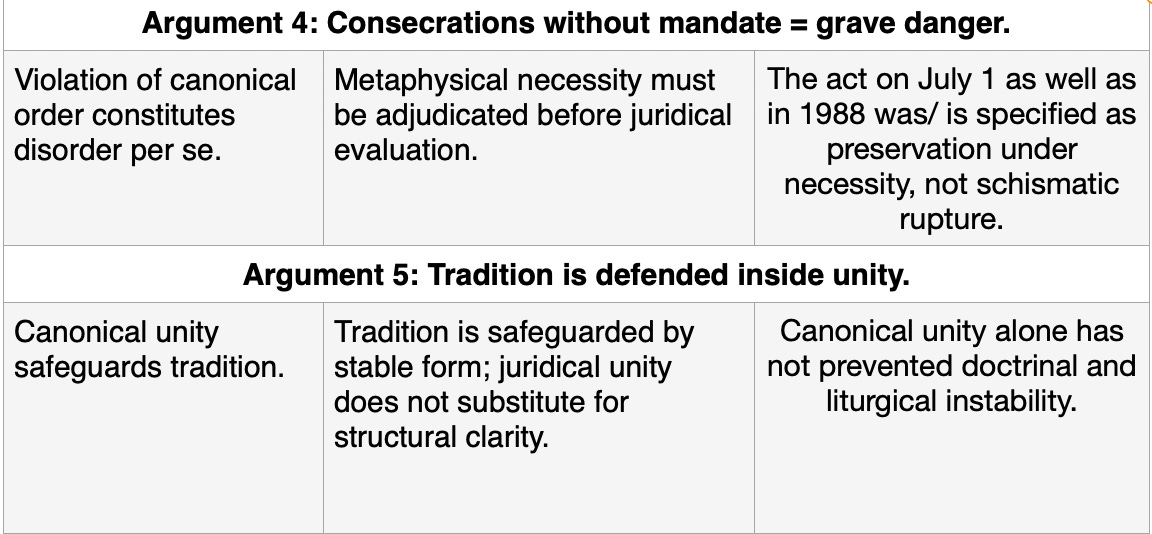
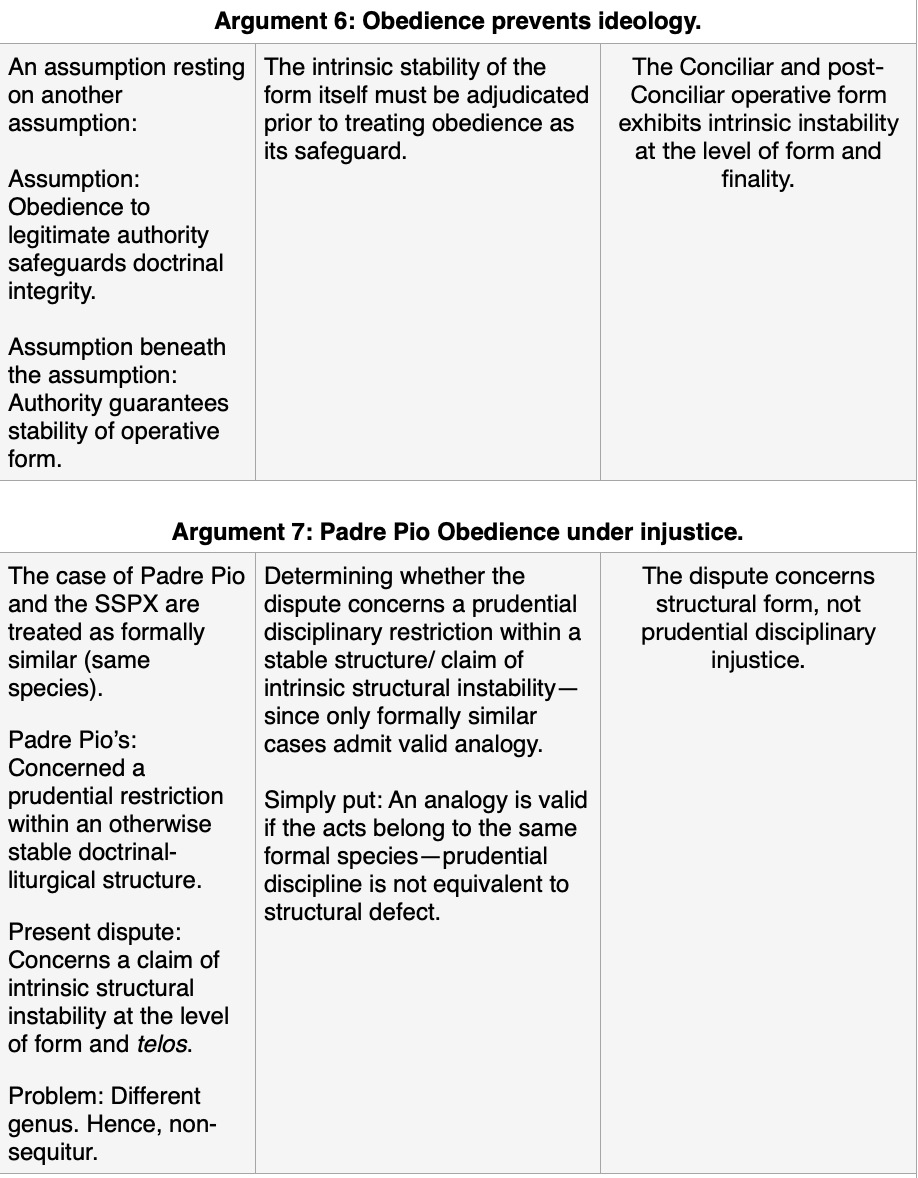
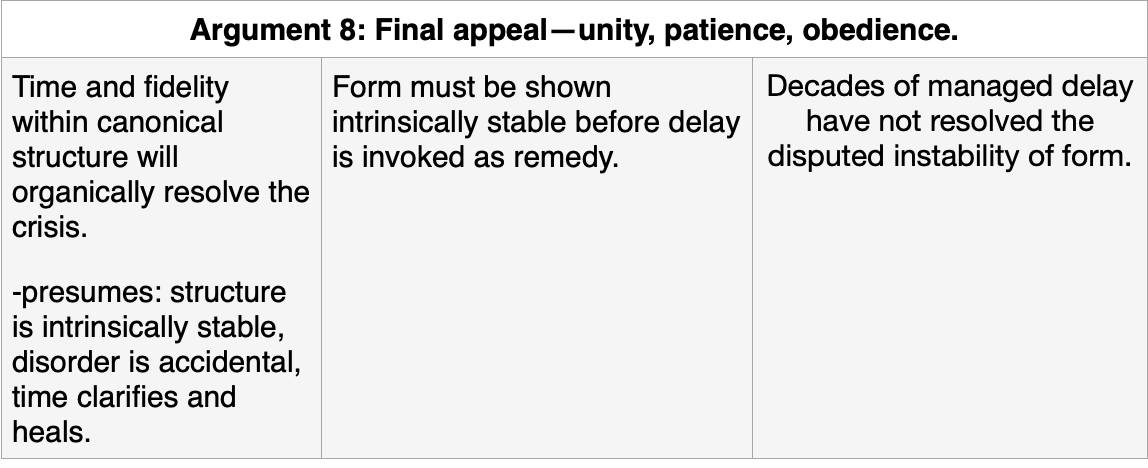
Lastly, we present the model we evolved utilizing a few known modern philosophers as metaphors, to serve as a more rhetorical expression of the problem with the missing hinge in the Cardinal’s arguments—the metaphysical pertaining to form and telos.
We argue, bypassing the metaphysical order of judgment creates a Cartesian-style enclosure: methodological coherence prior to ontological adjudication. By Cartesian, we mean—a system internally coherent within its methodological premises (think of an arcade), but divorced from the metaphysical grounding required for proper adjudication. We are not implying the Cardinal is consciously Cartesian. We are merely describing the structural resemblance with a Cartesian ontology, when questions of form and telos in the metaphysical realm are bypassed and ignored. This is analogical, for a more rhetorical and hence, effective way of explaining the landscape.
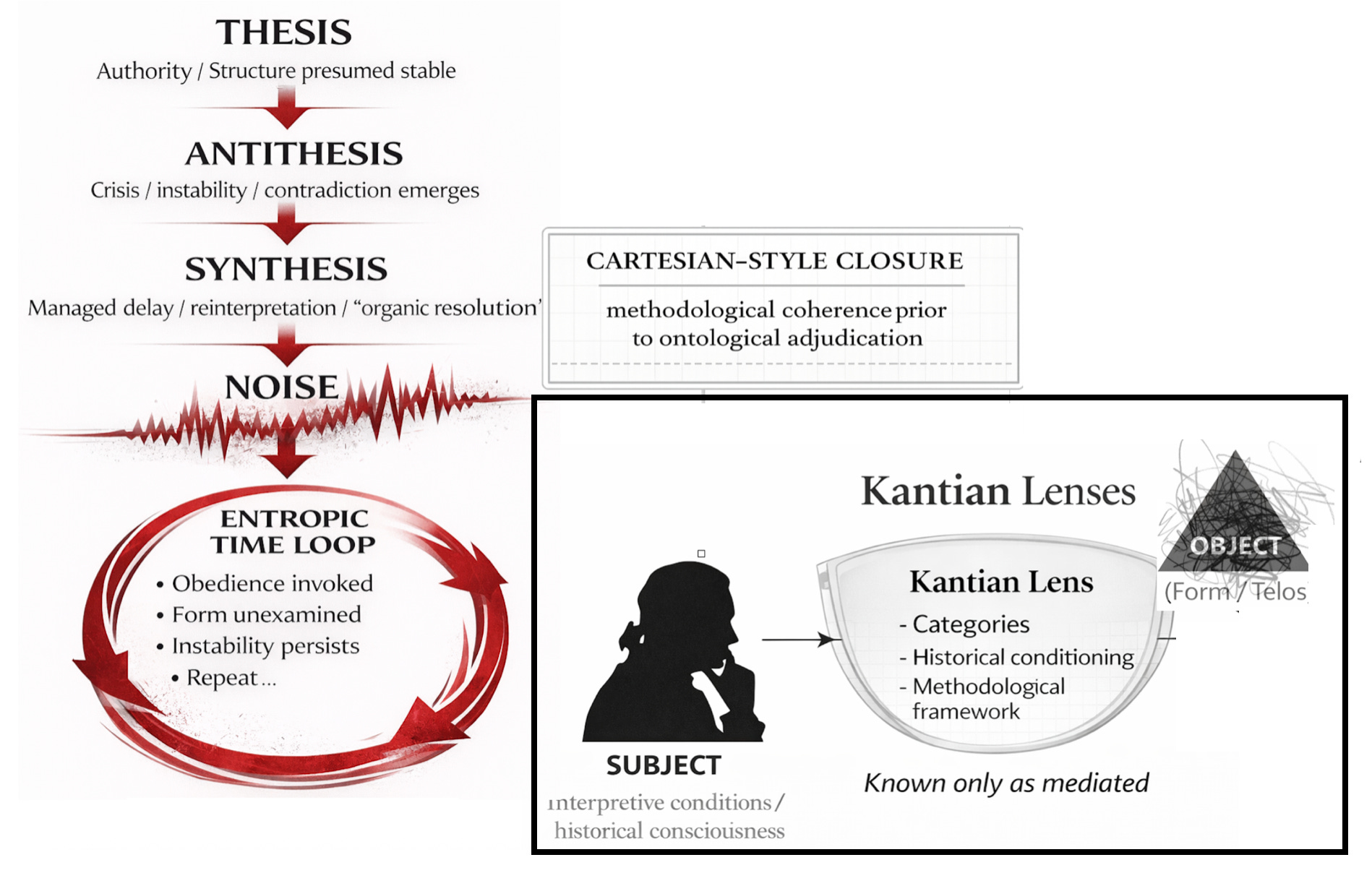
Below the Cartesian enclosure, we invoke our next analogical metaphor—the Kantian lenses. Here we describe how the subject views reality as he presumes structure via conceptual mediation rather than adjudicated form. We are not asserting philosophical genealogy, but are merely making a structural analogy as we did with the Cartesian enclosure (plane)—where all of this thus far operates. We are not projecting German idealism onto the Cardinal. Like the former metaphor this is all analogical.
Finally, we invoke our last modern philosopher as a metaphor—Hegel—where we follow the movement of thesis into antithesis (a consequence of remaining on the lower levels within a Cartesian enclosure), inevitably yielding noise, and an entropic time loop (another metaphor invoked to illustrate the cycle in perpetuity). Some might argue and say—Hegel is an inappropriate metaphor since his dialectical development is towards a higher synthesis, but that our loop is circular instability without resolution. So strictly speaking, they might claim we are not depicting classical Hegelian dialectic, given we are depicting failed dialectic collapsing into entropy. But from a classical metaphysical standpoint, if truth is participation in being, stable form grounded in act, and fixed according to nature and end—Hegel makes a contradiction internal to reality, hence becoming constitutive of truth, rendering negation “productive”. This means form is no longer stable, essence is no longer fixed, and truth becomes historical. Hence, the Hegelian claim of “higher synthesis” is actually a loss of metaphysical stability—entropic in the classical sense because stability gives way to process, identity gives way to development, and being gives way to becoming. So from a Thomistic ontology (our premise), Hegelian development dissolves metaphysical fixity. It is entropic when measured against classical metaphysics, of which we are fundamentally premised.
We conclude: Once form is no longer judged as intrinsic to the object, interpretation becomes conditioned by lenses rather than participation in being. And when essence is left unresolved (as it has for over 60 years), stability is sought through historical movement rather than metaphysical clarity. These would be things like appeals of the “hermeneutic of continuity” and “reform of the reform” disciples and promoters. But as we demonstrated earlier, from a metaphysical perspective the yield is entropic. Even the devolving conditions as they have unfolded corroborate the metaphysical adjudication. Therefore, given the prior formal specification of instability at the level of operative form and finality (now also supported by the historical movement itself after 60 years), an appeal to obedience without addressing that instability cannot adequately serve the good of the Church. Moreover, the Cardinal’s appeal does not sufficiently address the formal question upon which the good of the Church depends—inverting the order of judgment upon which ecclesial good depends—placing the cart before the horse.
We will end this piece as we did the previous on the Four Levels of Explanation and Why Debates Never Resolve (a Time Loop!), where we also identified the virtuous yield of addressing and hence, proceeding from the metaphysical aside from just resolving issues and reducing noise and entropy—the cardinal virtues, where prudence governs action, justice orders judgment, fortitude sustains perseverance, and temperance restrains excess; and the theological virtues of faith, hope, and charity—thereby restoring our vision of the Logos in a world, built for the pull of the lower registers.
Katharia, you're such a brainiac! <3
When I read Pope St. Pius X's encyclical on Modernism years ago, I couldn't really understand it.
But when I read the _Catechism On Modernism_ by Father Lemius back in 2017, I understood what it is.
https://archive.org/details/catechismonmoder00lemiuoft/page/n13/mode/2up
In fact, it seemed to me as if Pope Francis was using that catechism as his playbook! : )
I wonder if I am the only one of your fans who would greatly profit if you could provide us with a catechism of what you're saying?